
Theorem: The Credit Yet to Be Earned
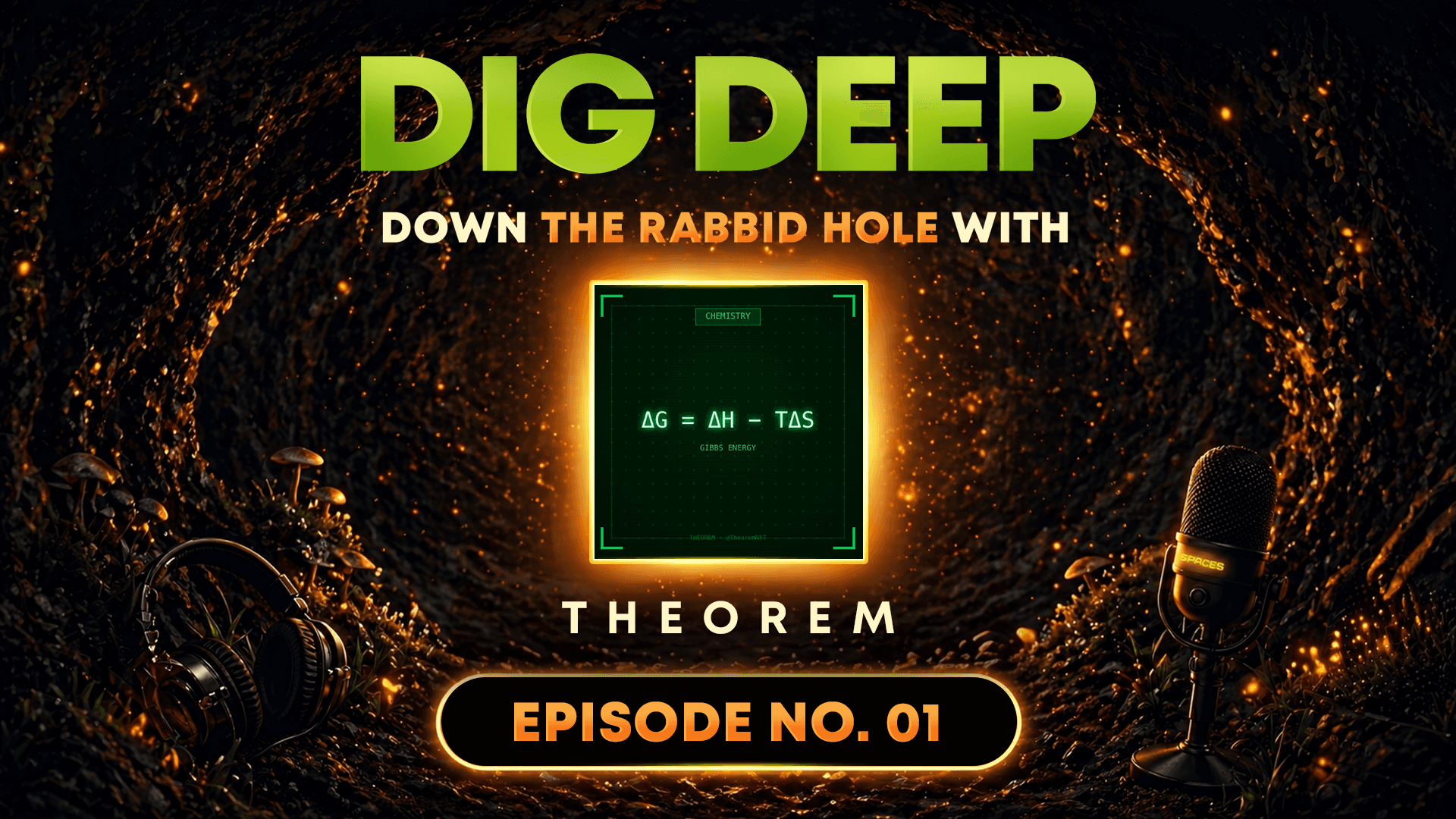
Dig Deep E001. The first Rabbid Hole deep-dive found the format live. Three weeks after mint, Theorem now has to prove it can survive the post-mint middle.
Under the lamp
Theorem minted free, sold out at 1,338, and now sits in the uncomfortable middle every free mint hits once attention fades. A balanced post-mint read on .87, the formula-art thesis, and what the next 90 days have to prove.
Current read
The pieces don't all line up yet. More clarity needed.
Receipts
What would change the read
New evidence can move the stamp. This file is the read at the time it was published.
The Burrow is where these questions get sharpened before a file hits The Surface.
Rabbid Hole hosted a Dig Deep session with this project. This read draws on that conversation, public materials, and our own checks. Not financial advice.
Receipts drawer
Theorem
1,338 pixel-art renderings of real scientific and mathematical formulas. Free mint on Ethereum.
Dig Deep E001 aired Mon 13 April 2026. It was the first episode of Rabbid Hole's deep-dive series, hosted by Naeem and Doc NooNoo with .87 (@ofalamin) of Theorem in the chair. Three days later, on 16 April, Theorem minted free on Ethereum and sold out at 1,338. Three weeks on, the secondary market is thin and the project sits in the uncomfortable middle every free mint hits once the attention fades. This is a balanced post-mint read, grounded in the AMA itself and what's happened since.
The episode that taught us the format
E001 was a rougher show than the ones that followed. The intro music was inaudible. There was an echo on stage for the first ten minutes. Mic invites refused to land. The guest joined late because he was making iftar for his sister. NooNoo opened the call by admitting it was their first space and that they were uncomfortable.
None of that ended up mattering.
The show found its shape live. By the back half, Esh from Yukis, Peanut from Long Lost, PLA, supertyer, darkanft and amgoodcity had all stepped on stage to push, praise, or challenge. What started as a structured AMA turned into a builder roundtable. That accidental format became the template the rest of the series uses now.
If you want to know why Dig Deep is a roundtable as much as an interview, the answer is in this episode.
The founder
.87's real name is Alamin. Nigerian, based in Nigeria, graduated from Ahmadu Bello University in Zaria in 2024 with a degree in automotive engineering. Full-time Web3 for the past two years. Into the space since 2020.
His path is unusual. He started on NEAR before moving to Ethereum NFTs. His first big NFT win was Ragnarok at the back end of 2021, minted at around 0.7 ETH and sold near 3 ETH. He farmed airdrops across zkSync, StarkNet, Aptos and Arbitrum, catching the Arbitrum drop on three wallets, which he described on the show as one of his bigger career moments.
He's also a content creator. X guides on airdrop hunting and farming. Browser extensions that he built himself, including one for unfollowing non-followers with a whitelist protector and another for bulk-deleting old posts by keyword on a delay so the platform doesn't flag the wallet.
When NooNoo asked about hobbies outside Web3, the answer was "vibe coding." That's not a flippant answer. It's the through-line. .87 is an operator who likes building small tools, and Theorem is the first time he's built something whose audience is the public rather than himself.
The relevance is simple. Small NFT projects don't usually die from lack of vision. They die when the founder runs out of energy or focus once the easy attention has gone. .87 has the right kind of curiosity. The open question is whether that curiosity converts into sustained operating cadence over the next two quarters.
supertyer made a point on air that's worth keeping in view. Nigerian founders shipping public Web3 projects from inside Nigeria are rare. The infrastructure is harder. The visibility is lower. The expectation gap is wider. He invested over $2.5M in NFTs since 2021 without recouping it, and he still went out of his way to publicly back this one. That endorsement isn't decisive, but it's worth registering.
What Theorem actually is
1,338 pieces on Ethereum. Free mint. Reveal at mint. Four domains: Chaos Theory, Physics, Maths, Chemistry. 60 real formulas spread across those domains. Each piece pairs a formula with its discoverer, in pixel art, with a sequential number lower-left.
.87 verified on the show that every equation and every named author is real. No fabricated formulas. No fictional mathematicians.
He was also clear about how the art is produced. He is the sole artist. The process he calls "vibe coding" is generative, built in JavaScript, with engines and parameters he wrote and steers. It is not an AI prompt. It is a generative art pipeline he iterates on directly. He said he produced more than ten full versions before locking the final collection.
The visual language is cleanly chosen. Pixel art for textbook formulas reads as cultural artefact rather than as PFP. That's deliberate. Theorem is not trying to be a timeline army or an identity flex. It's a digital poster, framed equation, formula card, study totem. The right frame is collectible artefact, not avatar.
That is honest, and it is also the project's hardest constraint. PFPs spread through identity. Memes spread through humour. Game assets spread through use. Formula art has to spread through taste, novelty, and collector interest in a market where collector budgets are thin and most of the room is chasing utility narratives.
It's a real lane. It's also a narrow one.
What he got right on distribution
This was the cleanest part of the AMA, and the part that's aged best.
.87 was specific about the problems he sees in NFT distribution today. Over-allocation. Fake guaranteed spots. FCFS scrambles that punish anyone outside North American time zones. Big communities demanding hundred-plus spot blocks because they're used to getting them. He ran two phases of collabs, prioritised X raffles in phase two, refused the larger-block requests when they didn't fit a 1,338 supply, and held a chunk of the whitelist back for community games rather than spraying allocations to chase vanity metrics.
The wallet submission window closed on the day of the AMA, which gave whitelist holders a fair window to submit and avoided the timezone trap.
None of this is glamorous. It's also not theatre. He understood the failure modes of free-mint distribution and tried to avoid the worst version of each one. The post-mint holder distribution suggests it broadly worked. The mint sold out cleanly without a single wallet hoovering supply.
That's a good piece of work. It deserves credit.
The mint and the market answer so far
Theorem minted on 16 April 2026 and sold out at 1,338 pieces. Three weeks on, the floor sits in the low single-digit USD range on OpenSea, with secondary volume modest and holder spread decent for the supply.
For a free mint in the current cycle, that is not a disaster. It is also not a breakout. It's the exact middle ground that tells you nothing about the project's long-term outcome and everything about what the next 90 days have to do.
Free mint at a thin floor is the moment the story stops being about mint mechanics and starts being about behaviour. Does the founder show up consistently? Does the team build a rhythm? Do holders get a reason to care that isn't price? Does the concept become a living thing or stay as 1,338 nice-looking formula cards quietly listed on OpenSea?
No one knows yet. That's the honest answer.
The sustainability fight
This was the most contentious AMA moment we've had in the series, and it's worth recording properly because the questions still apply.
Four different builders pushed on the same nerve. supertyer asked why a Nigerian founder who needs to make a living was running a free mint at all. PLA asked the funding question directly. Esh from Yukis, fresh from his own post-mint funding fight at Yukis, asked .87 what avenues he had for sustaining development once the mint was over. Peanut from Long Lost offered a more measured framing: free mints widen access and bring in creatives who'd otherwise be priced out, but they create their own pressure to prove value.
.87's answer was consistent across each pass. The team holds a treasury vault of NFTs, separate from the team allocation. Those treasury NFTs can be sold into secondary to fund development. If that isn't enough, he'd use his own funds.
That answer is sincere. It is also fragile, and the post-mint floor makes the fragility easier to see. A treasury of NFTs is only valuable if there's secondary demand. At a thin floor, selling the treasury creates more downward pressure rather than producing meaningful funding. The model can work if Theorem develops a real collector base. It cannot work as a substitute for one.
The more useful version of Esh's advice is the one .87 himself acknowledged on air. Multiple avenues. Print drops. Educational products. Licensing the imagery to study or science-adjacent brands. Anything that turns the formula concept into recurring revenue without depending on secondary demand for an internal NFT vault.
Whether that translates into actual diversification is a question the next two quarters answer.
The no-roadmap stance
.87 was clear there was no fixed roadmap. Utility was being shaped post-mint with the holder community, through a verified-holder Discord channel.
There is a fair version of that answer and a weak version.
The fair version is that most NFT roadmaps are theatre. They promise games, merch, tokens, staking, IP deals, lore universes, IRL events, comics and animation before the team has shipped anything for six straight weeks. Theorem dodged that trap. Reasonable.
The weak version is that "the community decides" can become a soft way of saying nobody has decided. Community input is useful with structure around it. What are holders deciding? On what cadence? Through what mechanism? What is the first decision? What is the first deliverable?
Without that scaffolding, holder governance is just a Discord role. Theorem doesn't need a giant roadmap. It needs a visible first loop. A weekly formula write-up. A monthly holder vote on a print drop. A quarterly extension that ships. The exact shape matters less than the cadence of evidence.
Right now the post-mint cadence is the missing piece, not the ambition.
The team
Real but small. AZ (@Azee_zatou), FK and Ajax handle collabs. FK is .87's university friend and the person who introduced him to NFTs. Shalin is the moderator running Discord. The team operates collaboratively, with members crossing roles when needed.
This isn't a red flag at this size. Many early projects are founder-heavy. It does mean Theorem's centre of gravity is .87. Founder. Sole artist. Engineer. Public face. Strategic lead. Likely community anchor.
That is a lot of jobs for one person, and post-mint is the season where that load shows.
The bull case
- A distinctive concept in a market full of derivative work. Formulas as cultural artefact is a clean lane that almost nobody else is in.
- Distribution discipline that held under pressure. Refusing the easy whitelist scrape is rarer than it should be.
- Verifiable founder track record. Shipped browser extensions, airdrop farming history, prior NFT trades, the published equations all check out.
- Free mint with no presale and no overallocation is the cleanest possible launch. There are no insiders to dump on retail because the structure didn't permit them.
- The founder is a low-ego operator who took the live criticism on stage and noted it down rather than getting defensive. That is a real signal about how he handles feedback.
The bear case
- Free mint, no token, no concrete utility, no fixed roadmap and a thin floor is a hard combination to grow from. Conviction has to come from the art itself, and the audience for formula-as-art is narrower than the audience for almost any other NFT format.
- The treasury-NFT funding model is not robust against a weak floor. Selling treasury into thin demand is not a runway, it's a slide.
- Around 4,800 followers on the project account is a small audience to convert into a sustained collector base. That has to grow without paid amplification or it caps the upside.
- Sole-artist, sole-public-face structure means the project's stamina is the founder's stamina. Burnout, life events, or attention shifts hit the project directly with no buffer.
- "Community decides" is a real principle but currently lacks operational shape. The first concrete deliverable from holder governance is the credibility test.
What we're watching, next 90 days
Five things, in priority order.
First, post-mint cadence. We want to see weekly visible output from the team. Doesn't need to be huge. A formula write-up, a behind-the-scenes piece on the generative pipeline, a holder spotlight, a Discord call summary. Cadence is the credibility currency for projects in this position.
Second, treasury transparency. How many treasury NFTs does the team actually hold? What is the rule for selling them? At what floor does the team stop and look at alternatives? If treasury sales are happening, holders should be able to see them.
Third, the first concrete post-mint deliverable. Whatever it is. Print drop, public art install, educational product, licensed remix. Something that turns the concept into evidence.
Fourth, holder retention versus listing rate. A thin floor with low listing pressure is healthier than a thin floor with high listing pressure. The shape of the order book matters more than the headline number.
Fifth, .87's stamina. Public posting cadence on @ofalamin and @TheoremNFT. Visible energy in Discord. Engagement with the holder voices that pushed back. The hardest part of running a small NFT project is staying interesting in month four when the algorithm has moved on.
The honest read, three weeks in
Theorem is not a rug. It is not a runaway. It is a small, sincere, slightly unusual NFT project from a thoughtful young Nigerian founder with a coherent visual concept, clean distribution principles and a financial model that depends on either a stronger secondary market or explicit founder funding to last.
The AMA gave us a clear picture of who .87 is and what he wants Theorem to be. The mint gave us evidence that the distribution mechanics worked. The post-mint window is the part where we don't have answers yet, and the part where the next two quarters do all the actual storytelling.
For now, the credit is for craft, fairness and conviction. The credit yet to be earned is for post-mint survival.
Both can be true at once.
The Rabbid Hole verdict: needs more light. Not a pass. Not a sweep. Not a pat on the head because the founder was nice. A watching brief on a project that has something, but now has to prove that something can move.
Disclosure
Theorem joined Rabbid Hole for Dig Deep E001 on 13 April 2026 and minted on 16 April 2026. This piece is an editorial read grounded in the AMA, the Lurky transcript and summary, and the project's live post-mint state. Not financial advice. Not a mint call. Rabbid Hole had allocation, minted, and currently holds Theorem NFTs, which should be factored into how you read any of this.
Follow @TheoremNFT and @ofalamin for the next chapter. We will revisit the watchlist when there is new evidence.
Dig Deep E001, hosted by The Rabbid Hole.
Needs More Light.
The pieces don't all line up yet. More clarity needed.
What this is not
Not a price target. Not a paid cheer. A public read on what survived the questions available at filing time.
Keep digging
Nearby holes.
Same archive, different angle. Useful if this file raised more questions than it closed.
Want the questions before they become a case file?
The Burrow is where the next holes get opened, argued over, and cleaned up before they surface.