The Little Guys: What the Mint Quietly Confirmed
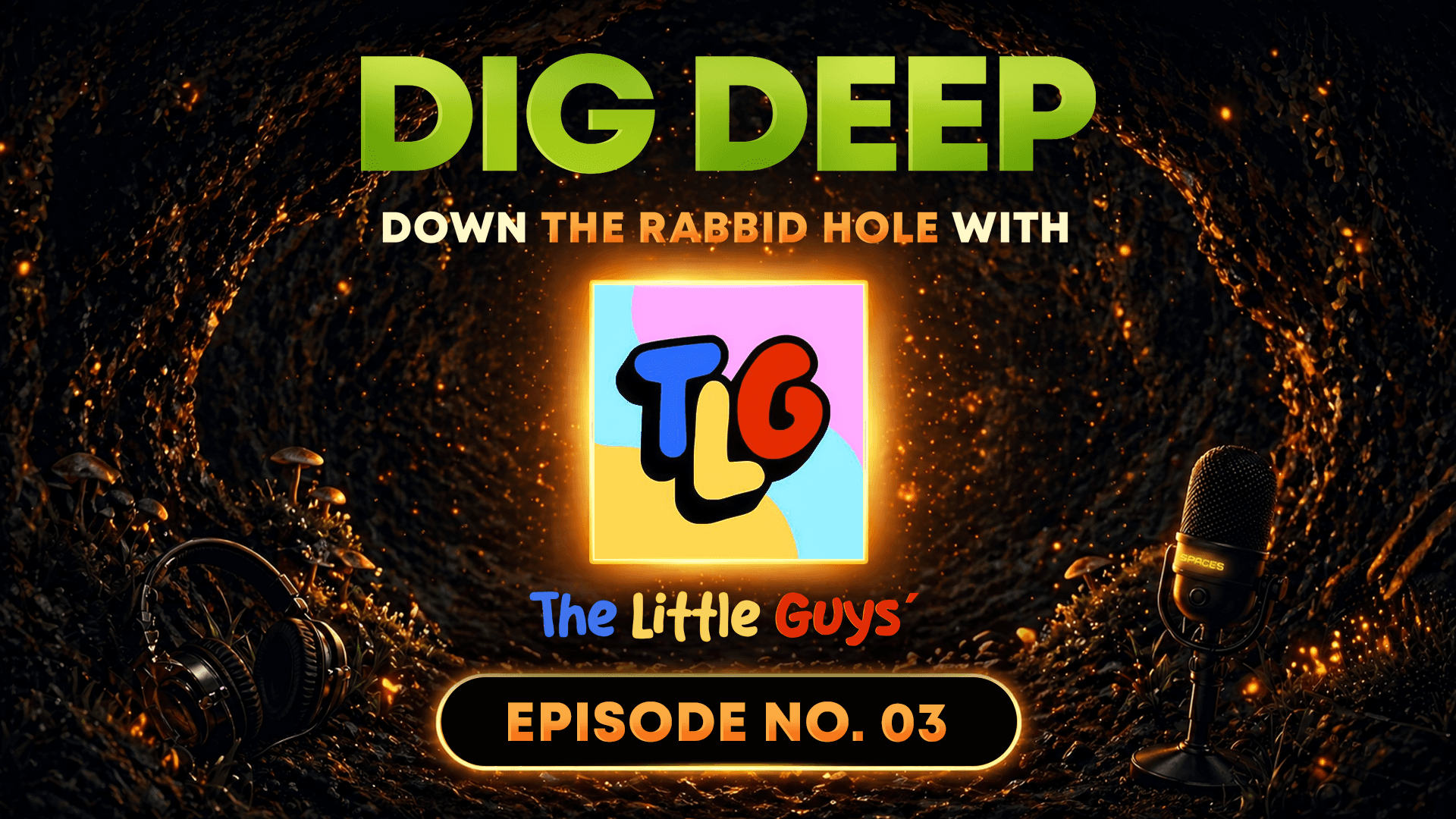
Dig Deep E003. Dom Domingo brought a real team, shelf-ready art, and a Web3-first toy thesis. The mint underperformed, and the AMA already told us why.
Under the lamp
The Little Guys had more substance than most early Ethereum projects: real founder, real team, production-aware art, and manufacturing intent. The mint did not reflect that, and the reasons were audible in the AMA.
Current read
Not for us, not now. We'll revisit if things change.
Receipts
What would change the read
New evidence can move the stamp. This file is the read at the time it was published.
The Burrow is where these questions get sharpened before a file hits The Surface.
Rabbid Hole hosted a Dig Deep session with this project. This read draws on that conversation, public materials, and our own checks. Not financial advice.
Receipts drawer
The Little Guys
Ethereum NFT project aiming to build a toy and IP brand around cute, family-friendly characters, founder funding, and shelf-ready art direction.
Dig Deep E003. Eighty-five minutes with Dom Domingo (@DonDomingoNft) of The Little Guys, recorded April 2026. The mint has since landed, and underperformed. This is what the AMA told us, and what the mint has quietly confirmed.
Most NFT post-mortems are written by people who weren't in the room. We were. So this isn't a write-off, and it isn't a rehabilitation. It's a careful read of what Dom said on air, set against what's happened since.
The Little Guys came into the cycle with more substance than most early Ethereum projects. Real founder. Real team. Production-ready art. Real manufacturing conversations. The mint didn't reflect any of that, and the reasons were mostly audible in the AMA itself if you were listening for them.
Here's how we're reading it now.
The founder we met
Dom isn't a Web3 native. He runs a Web2 business with around 80 employees in sales and customer service. Seven kids. A wife who teaches at school because she loves it. The day job runs well enough that he can choose his own hours, and he chose to put them into The Little Guys.
He came into NFTs roughly two years ago, well after the peak. Friends were in Bored Apes and Pudgys early. He watched, assumed it would fade. Eventually bought in.
His first love was the minting moment and the rare-pull thrill. That romance stayed in his voice the whole time he was on air. The toy company dream predates Web3 by a long way, and his wife was the one who pushed him to actually do something about it. He chose to route it through Web3 because that was where he'd fallen for the medium. That detail frames almost every later decision, including the ones that didn't pay off.
The team that read real
This was one of the strongest parts of the conversation, and it remains one of the strongest things about the project. Most early NFT teams overstate themselves by about three times. Dom's structure read closer to reality.
The Professor is a co-founder, an old school friend, and a former toy maker. Not "advisor who once worked in toys." Actually a toy maker. When Dom sketches an idea, the Professor draws it and tells him whether it can be physically produced. That feedback loop is rare this early in an NFT project.
Hazel is the lead artist and lead animator. Dom said repeatedly that he has to ask Hazel to stop making new traits. That's a good problem to have.
Bonnie was hired for community after eight interviews. The stated filter was belief first, qualifications second. That can age badly. For a project at this stage it was probably the right instinct.
Dom's wife holds the IP work, the character development, and the structured documentation side of the operation. School teacher background. By Dom's own description, she's the calm to his popcorn brain. That partnership is doing real work behind the scenes.
Jacek (7xBunny) and the Connectivity team sit outside the core as Web3 strategy and collab support. The Lurky transcript wasn't always crisp on attribution, so this is worth flagging plainly. What Dom actually said on air is that they help bridge the Web2-to-Web3 gap. 7xBunny came on mic during the show to vouch for him, and her line about Dom not "bossing on you" landed as one of the more authentic moments of the episode.
The one detail the AMA gave us that almost no founder offers this early is that Dom's seven kids are an unfiltered focus group. New traits get shown to them daily. They tell him what's cute and what isn't, with no Web3 politeness layer. That's a quietly interesting product loop, and it's the kind of thing that gets dismissed as cute but actually matters when you're designing for shelf appeal.
Character first, PFP second
The art direction was clear and consistent. Cute. Big eyes, big mouth. Manufacturable as a plushie. Dom mentioned the team had to add a thumb after realising a Little Guy looked amputated when clothed. That's the level of detail you want from a team planning to put product on a shelf.
Dom was also deliberate about avoiding the standard trait-stack playbook. No laser eyes. No lazy crypto tropes. Seven 1-of-1s, one for each of his kids. A village-style world structure with characters like Michael the Mechanic carrying their own backstories.
What the AMA didn't deliver, and what the mint arguably reflected, was the lore itself. Dom's argument was that premature reveal would burn the content piece they were planning to launch with it. Defensible in principle. Less defensible in a market where community belief needs something to chew on. The gap between "we have lore" and "here's a character backstory dropping weekly" was wide on air, and it stayed wide through to mint.
The mint communication gap
This is the part of the AMA that aged the worst, and the part of the project that arguably mattered most.
Esh asked for mint detail. Adrian pushed harder. Widow took it further. Dom's answer to all of it was the same. It's not time yet. The art is ready. The plan is locked. The reveal has to follow the story.
The audience wasn't buying the framing. And to be fair to them, they were right.
We're not in a market where founders get the benefit of the doubt anymore. Holders want a rough price band, a rough supply number, and a rough window. Early enough to load a wallet, talk it through with friends, and decide whether they're actually in. Dom's view was that revealing too early kills hype and invites noise. There's truth in that. But the audience wasn't asking for the full mint-day deck. They were asking for a range.
Adrian's read landed clearest. His point, said out loud on air, was that Dom was "very good at avoiding the questions." That isn't a personal shot. It's a fair observation about how much spec was being held back.
Dom committed on air to take the feedback to the team. A price range did surface eventually, but later than the audience needed it to be useful, and a secondary effect was that whitelist holders had been earning allocations without yet knowing what they were earning the right to pay for. That misalignment compounded.
The post-mint result confirmed the read. The opacity didn't just slow the mint. It eroded the conversion of attention into participation. The AMA crowd flagged that risk in real time. It played out roughly as flagged.
The Web3-first thesis under pressure
Widow's question was the sharpest of the episode, and it's the one the project still hasn't answered cleanly.
Her challenge: The Little Guys reads like a Web2 product. Plushies, family-friendly mascots, an IP play with retail intent. Why launch into a 5-to-10k Web3 audience instead of the eight billion people in Web2 first? Dom's answer was honest and consistent. He'd fallen for Web3. He wanted to onboard Web2 users back into Web3 through the project, not extract from Web3 and exit to Web2. He'd turned down investor offers that would have routed the project straight to retail.
Defensible position. Also a harder commercial path. The audience needed the project to articulate the Web3-native value proposition at the NFT layer specifically. What does the NFT actually confer that the eventual retail plushie won't? Commercial rights, royalties on licensed merch, exclusive drops, early access, governance over which characters get produced. Dom hinted at "interactive elements" and pointed at roadmap clues. He named Pudgy Penguins as the comparison. Pudgy's NFT-holder utility stack is still thin relative to its retail distribution, and that's exactly the trap The Little Guys would need a different answer to.
The mint outcome makes this less of an academic question. A Web3-first launch is only worth the discount if the Web3 layer is doing meaningful work for the holder. That work needs to be visible.
Self-funded, principled, and what that holds
Self-funded. No outside investors, by choice. Manufacturing conversations and prototypes already in motion. Animation already costing real money. Multiple revenue streams planned beyond royalties.
The self-funded piece is the strongest signal on the table. Dom turned down investor money that would have given him scale in exchange for control. He's putting his own capital on the line. He said on air that if the mint underperformed, he'd continue building from his own funds rather than force a team mint-out and walk away. He's now in that scenario, and the next two quarters will tell us whether the commitment held.
The weakness was the absence of public commercial detail. Unit economics. First retail partner. Manufacturing country. First SKU. First shelf date. Naeem pushed on it. Dom wouldn't land any of the specifics. Some of that was legitimate competitive caution. Some of it was probably that the numbers weren't fully fixed, which is fine. But the gap between "we have plans A through E" and "here's the first plushie prototype you can hold" was the gap that would have done the most to validate the mint. It didn't get closed in time.
Dom's bullish/bearish round was actually one of the cleaner founder snapshots we've recorded. Mega bullish on Web3 brands breaking into Web2 markets. Bullish on IP-driven projects, community-led brands with real leadership, royalties as a continuing primitive. Bearish on pure PFPs, on team-forced mints, on celebrity partnerships where the intent is hollow. That's a coherent worldview. The challenge isn't the worldview. It's whether the execution catches up to it.
The accountability ask
At the end of the episode we asked Dom for one concrete thing to be held to in twelve months. NooNoo landed the question. His answer was that he'd give it everything he had.
Honest. Soft.
The Fugz answer in E002 was specific. NFC-chipped plushies, hold me to it. That's the sort of commitment a community can date a calendar against. Dom's was a character commitment rather than a deliverable commitment. It was the right answer about him as a person. It wasn't the right answer about the project.
Post-mint, this matters more, not less. The most useful thing Dom can do over the next two quarters is name a deliverable a stranger could verify. A first retail SKU, a signed licensing partner with a name attached, or an animation episode with a release date. Anything that converts the brand from intention into something a non-believer can touch.
The honest read, after the mint
The Little Guys has a founder with real operating experience, a team with genuine execution signal, art that was production-ready months ago, a distribution model that filtered for the right people, and a principled stance on paid mints and Web3-first rollout. That combination was rare in April. It's still rare today.
It also went into mint with a communication gap the audience called out twice on air, a Web3-layer utility story that hadn't been sharpened, an IP-to-retail thesis that remained unproven, and an accountability commitment that was about character rather than calendar. None of those alone are fatal. Together they explain a lot of what happened.
The verdict for now is pass. Mints don't end projects. Quiet quarters do. The question over the next six months is whether Dom does what he said he'd do on air. Keep building from his own capital. Drop a physical sample people can hold. Give the NFT layer real work to do. Communicate plainly and early.
If he does, the underwhelming mint becomes a footnote in a longer story.
If he doesn't, the AMA becomes the most honest record of what the project was always going to be.
We're not telling anyone to mint, hold, or exit. That isn't this show's job. Our job is to listen carefully, write it down, and come back to it. We've done the first two parts. The third is still ahead of us.
See you in twelve months.
Dig Deep E003, hosted by The Rabbid Hole. Watch for a verifiable physical product, sharper NFT-holder value, and clearer public delivery dates.
Pass For Now.
Not for us, not now. We'll revisit if things change.
What this is not
Not a price target. Not a paid cheer. A public read on what survived the questions available at filing time.
Keep digging
Nearby holes.
Same archive, different angle. Useful if this file raised more questions than it closed.
Want the questions before they become a case file?
The Burrow is where the next holes get opened, argued over, and cleaned up before they surface.